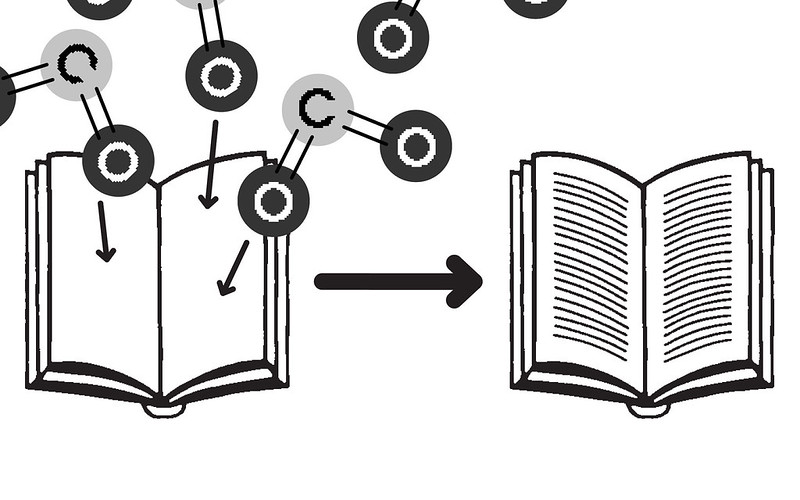
A Carbon Sequestering Book is speculative — a design fiction, not a built object. The idea: take every material that makes up a normal book and make the book carbon-neutral or carbon-negative in how it’s made, without offsetting. A book is a system of components, and each one is a different set of problems and opportunities for carbon sequestering
The material breakdown
Breaking the object down by component makes clear which parts are solved, which are procurement decisions already being made elsewhere, and which part is the genuine research leap:
| Component | Conventional | Viable today | Still speculative |
|---|---|---|---|
| Paper / substrate | Virgin tree pulp — carbon-positive from harvest and processing | Fresh Press: agricultural waste + perennial prairie grasses — carbon-neutral to carbon-negative | — |
| Ink carrier (oil) | Petroleum-derived mineral oil or linseed | Plant-based or algae-derived oils — lower embodied carbon, no fossil extraction | — |
| Ink pigment (black) | Carbon black from incomplete combustion of fossil fuels | Algae-derived carbon black — both the oil and the pigment can come from algae, closing the biological loop | ★ Pigment that forms on the page by drawing down CO₂ from the air |
| Binding adhesive | PVA (polyvinyl acetate — petroleum-derived) | Wheat starch, rice starch, natural hide glue — traditional bookbinding adhesives, biodegradable, reversible | ★ Tannin or lignin resin — fully plant-derived, potentially circular; lignin is a byproduct of the same pulp process that produces the paper, closing the material loop within the book itself |
| Cover board | Virgin fiber board | Recycled board or FSC-certified fiber | — |
Where it started
The idea grew out of Fresh Press, a project Eric Benson helped start at the University of Illinois Urbana-Champaign: a paper-making facility that replaces tree fiber with agricultural waste and perennial prairie grasses. The resulting paper is carbon-neutral or carbon-negative on its own. Printing ordinary oil-based ink on top of it felt like squandering that work.
The hard part: ink that draws down carbon
Algae-derived inks are a real and near-term option — the oil carrier and the carbon black pigment can both come from algae, replacing petroleum at both steps. Patagonia’s algae ink project with Living Ink demonstrated this is buildable today. That’s meaningful, but it doesn’t make the book carbon-negative. It makes it less bad.
The genuinely speculative idea is different: ink that prints clear and develops its black pigment over time by drawing CO₂ from the atmosphere — the book gets darker as it sequesters carbon. Two chemical pathways make this imaginable. The first is a pH-sensitive route: CO₂ dissolved in ambient moisture forms weakly acidic carbonic acid, and some natural dyes shift color with acidity — an ink that starts alkaline (clear) and darkens as CO₂ accumulates in its micro-environment could work on those principles. The second, harder pathway is direct atmospheric mineralization: high-pH materials like calcium hydroxide cure by absorbing CO₂ and converting it to calcium carbonate, the same reaction that hardens lime plaster and has been happening in Roman buildings for two millennia. Archival papers are already alkaline-buffered, already absorbing small amounts of CO₂ slowly — the carbon-sequestering book is partly just making that chemistry explicit.
Neither pathway is a solved product. The pH route responds to CO₂ concentration but doesn’t permanently lock carbon away; the mineralization route would, but the engineering gap between lab chemistry and a functional ink layer is wide. And there are alternative directions — white ink on a dark page, so the atmosphere lightens as carbon leaves it rather than the book darkening as it accumulates. The exact design is less important than the question: this is how design fiction is supposed to work. Making the idea concrete enough that someone wants to answer it is the job.
Where it led
I sent the idea to Eric Benson, his paper research was a starting off point for this, so I thought maybe he would have some ideas on the ink front. Eric didn't, but he did connect me with Marc O’Brien. The conversations that followed contributed to the founding of Climate Designers — a network now thousands strong, connecting designers working on climate around the globe. A speculative book that doesn’t yet exist helped start an organization that does. While I haven't yet found ink that draws down carbon, all those climate designers hopefully are.